Can You Wash Alcohol Out of Hair?
Decontamination for contaminated hair
Whether drugs/controlled substances, alcohol/EtG or external contamination: select the type of contamination and find the right AToxOut product.
What is your hair contaminated with?
Recommended for drug/substance residues
RID & CARE Set
Shampoo 400 ml + conditioner 200 ml

Recommended for alcohol/EtG residues
Hair Cleanser Ultra + Phase 2
Hair Cleanser Ultra 400 ml + Phase 2 200 ml

Recommended for external recontamination
DEKON Shampoo
Regular cleansing and care · 200 ml
Product recommendation based on the selected situation. Cosmetic products cannot guarantee a specific analysis result; for forensic questions, consult an accredited laboratory.
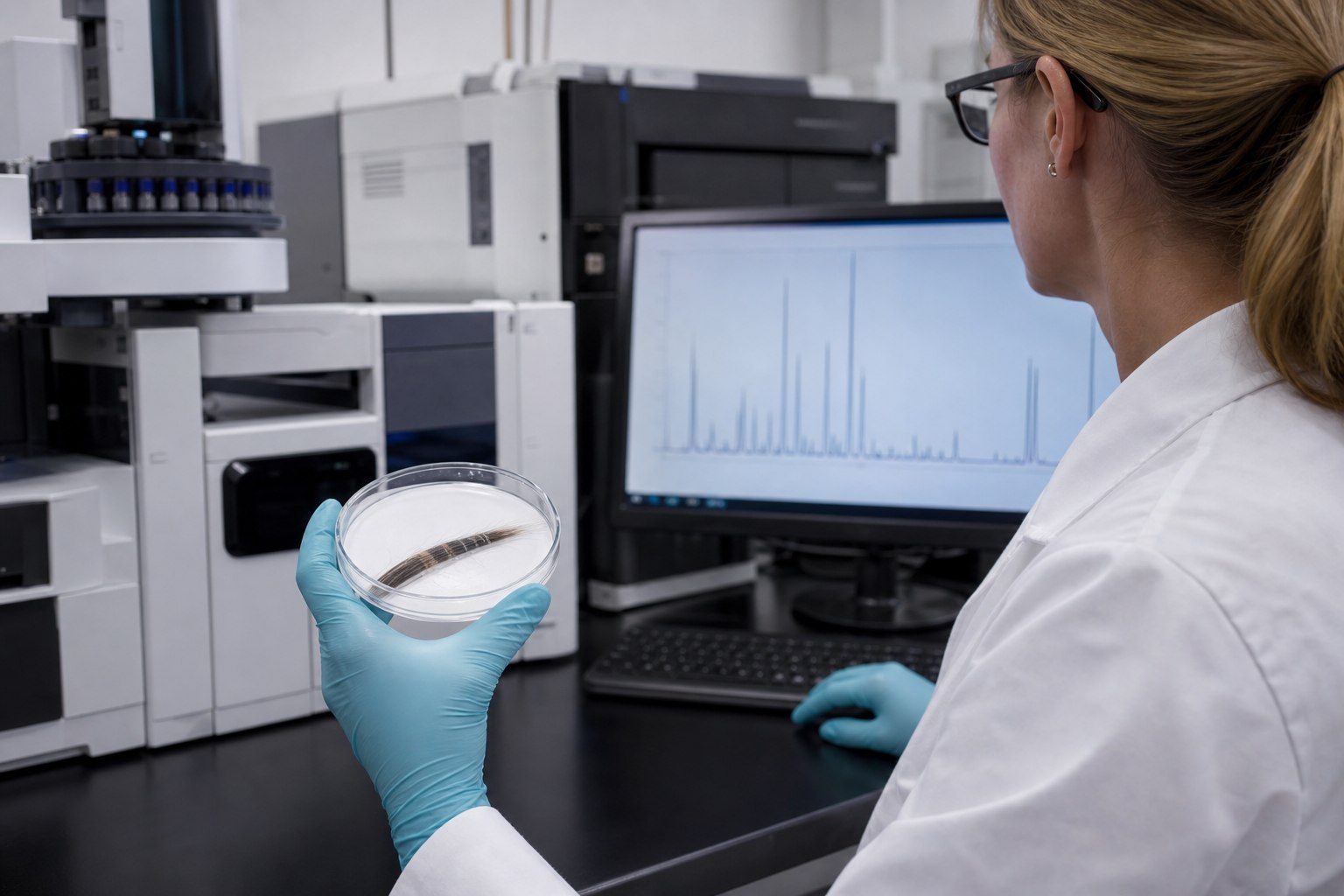
Many people wonder whether alcohol can be removed from their hair by simply washing their hair – especially when it comes to hair analysis. The answer is not that simple because alcohol breakdown products are stored deep in the hair structure. While conventional shampoos can remove surface residue, relevant markers such as ethyl glucuronide (EtG) and fatty acid ethyl ester (FAEE) remain. Scientific studies show that even chemical treatments only have a limited effect on the detectability of alcohol.
The most important things in brief
✅ Hair analyzes are accurate in the long term: They can detect alcohol consumption for months.
✅ Washing does not remove deeply embedded degradation products: EtG and FAEE remain despite washing your hair.
✅ Dyed hair is problematic: Hair dyes can distort the test results or make them unusable.
✅ Home remedies are ineffective: Vinegar, baking soda or cleaning shampoos do not remove ingrained alcohol.
✅ Laboratories are prepared for manipulations: Chemical changes in the hair are detected and can lead to the sample being invalid.
Understanding alcohol in hair
How alcohol is deposited in hair
After consuming alcohol, breakdown products accumulate in the hair, which happens gradually and not immediately. Hair analysis makes it possible to detect alcohol consumption over a longer period of time. Even the smallest amounts of alcohol, as can be found in certain foods, leave traces in the hair.
The lifespan of traces of alcohol in hair
The length of time alcohol can be detected in hair varies depending on the analysis method. In contrast to breathing air, where alcohol can only be detected for hours, alcohol in the blood can be detected immediately after consumption and remains detectable there for 2-3 days. A hair sample provides data for a long-term examination and can detect alcohol consumption over the past few months.
Hair with a minimum length of 3 centimeters is required for hair analysis, although tinted or colored hair can influence the analysis. The precision of laboratory tests and the ability to detect means of manipulating hair samples make hair analysis a reliable method for checking alcohol consumption.
Read also: This is how ETG can be destroyed in hair
Methods for washing alcohol out of hair
Shampooing and common hair cleaning practices
Shampooing your hair regularly can help remove alcohol residue by thoroughly cleaning the hair. Additionally, common hair cleaning practices such as using conditioner or special cleansing shampoos can help rid hair of alcohol residue. It is important to use mild shampoos to avoid damaging your hair and to ensure thorough cleaning.
The effectiveness of home remedies and myths
There are many myths and home remedies circulating that claim to wash alcohol out of your hair. From vinegar rinses to baking soda masks, however, the effectiveness of such methods is often questionable. While some home remedies can help clean the hair superficially, they cannot effectively remove deep-rooted alcohol deposits. It is advisable to rely on proven hair cleaning methods to thoroughly eliminate alcohol residue.
For more information about home remedies and myths, as well as their actual effectiveness in removing alcohol from hair, check out professional publications and expert-curated resources. It is important to use scientifically based methods to ensure effective hair cleaning.
Influence of hair treatments on alcohol detection
The role of hair color and bleach
Hair dyes and bleaches can affect the detection of alcohol in hair samples. Chemically speaking, they have no direct influence on the alcohol breakdown products that are stored deep in the hair. However, chemical treatments make hair analysis more difficult because they change the outer layers of the hair and can therefore influence the test result.
Potential consequences of chemical treatments
Using chemical treatments such as hair dyes and bleaches can lead to potential consequences when it comes to detecting alcohol in hair. Laboratories are advised to refuse hair analyzes on colored or tinted hair as these can distort the results. In such cases, alternative samples such as urine or other body hair are often used to ensure accurate results.
To ensure the validity of a hair analysis, it is advisable to avoid chemical treatments before providing a hair sample in order to avoid possible falsification of the results.
Professional approaches and test accuracy
How does hair analysis work to determine alcohol?
Hair analysis is one of the most accurate ways to detect long-term alcohol consumption. Two main markers are examined: ethyl glucuronide (EtG) and fatty acid ethyl ester (FAEE). These substances are created when alcohol is broken down and are stored in the hair via the blood supply. EtG is particularly reliable because it is not adulterated by external influences such as shampoos or styling products. FAEE, on the other hand, can be influenced by greasy hair care products.
The analysis is usually carried out by gas chromatography-mass spectrometry (GC-MS) or liquid chromatography with mass spectrometry coupling (LC-MS/MS). The hair is cut into small sections to reconstruct alcohol consumption over several months. Hair grows around 1 cm per month – so a 3 cm long hair sample provides information about consumption over the last 3 months.
Laboratory analysis and measurement methods
Nowadays, laboratories work extremely precisely and deliver corresponding results. Even the slightest amount of alcohol consumption, which can be found in certain foods, is reflected in the hair. A hair analysis can also be used to determine drinking behavior and alcohol consumption over the past few months. A 3 centimeter long hair sample can provide information about alcohol consumption over the last 3 months.
Factors affecting the reliability of hair alcohol tests
The ability of hair analysis to detect alcohol consumption is influenced by factors such as hair length, color and other external influences. A sufficiently long hair sample without coloring is required for a reliable analysis. Although it is reported that intensive hair washing can remove degradation products from the hair, some substances cannot be completely washed out. After a specific period of time, the breakdown products are firmly anchored in the hair and can no longer be removed.
Washing alcohol out of your hair – is that possible?
Washing alcohol out of your hair is a controversial practice. While it is theoretically possible to remove certain alcohol breakdown products by washing your hair, other substances are deeply anchored in the hair and cannot be removed so easily. In addition, washing your hair can change the external appearance of the hair and thus influence the results of a hair analysis.
Chemical agents for hair cleaning should be avoided as they can distort the analysis results. Ultimately, it is advisable to rely on reliable and recognized alcohol detection methods and not to use questionable practices.
FAQ:
How long does it take for alcohol to come out of your hair?
Alcohol itself does not stay in the hair for long, but the breakdown products such as ethyl glucuronide (EtG) can be stored in the hair. Hair analyzes can detect alcohol consumption up to three months after the last consumption, as hair grows about 1 cm per month and the hair sections examined usually represent the last three months.
Is alcohol harmful to hair?
Direct alcohol consumption has no specific damaging effect on the hair structure itself, but can indirectly affect hair health. Excessive alcohol consumption can lead to nutritional deficiencies, which can result in hair loss or deterioration in hair quality. Alcohol in hair care products, such as some styling products, can dry out hair, especially when present in high concentrations.
How much alcohol for hair analysis?
The amount of alcohol detected in a hair analysis depends on the sensitivity of the test and consumption behavior. For EtG, the usual limit is 7 pg/mg hair to indicate regular alcohol consumption. Values above this indicate frequent or heavy use, while lower values may indicate moderate or no use. Specific values may vary depending on the laboratory and standards used.
Sources:
- Pragst, F., & Yegles, M. (2008). Alcohol markers in hair. In Kintz, P. (Ed.), Analytical and Practical Aspects of Drug Testing in Hair (pp. 73-121). CRC Press.
https://www.taylorfrancis.com/chapters/edit/10.1201/9781420045079-9/alcohol-markers-hair-fritz-pragst-michel-yegles - Society of Hair Testing. (2019). Consensus for the Use of Alcohol Markers in Hair for Assessment of both Abstinence and Chronic Excessive Alcohol Consumption.
https://www.soht.org/images/pdf/Revision_2019/SOHT%202019%20Alcohol%20markers%20revision%2013JUN19%20FINAL.pdf - Crunelle, C. L., Yegles, M., van Nuijs, A. L., Covaci, A., De Doncker, M., Maudens, K. E., … & Neels, H. (2014). Hair ethyl glucuronide levels as a marker for alcohol use and abuse: a review of the current state of the art. Drug and alcohol dependence, 134, 1-11.
https://www.sciencedirect.com/science/article/abs/pii/S0376871613004638 - Federal Highway Research Institute. (2017). Formation of judgments in the assessment of fitness to drive: assessment criteria.
https://www.bast.de/BASt_2017/DE/Publikationen/Medien/VM-PDF/2017-12.pdf - Swiss Society for Forensic Medicine. (2017). Determination of ethyl glucuronide (EtG) in hair samples.
https://sgrm.ch/content/Forensische-Chemie-und-Toxikologie/Fachgruppe_Toxikologie/EtG_FINAL_2017.pdf